Knee Exercises


1. Gout   https://gathiyarog.com/

One of the most common causes of joint pain is gout. Gout is a type of arthritis that can cause periods of intense pain to occur, known as gout attacks. During such periods, patients with gout will usually experience swelling in the affected joints. Gout can also affect the big toe. The main cause of gout is a build-up of uric acid in the blood.


2.Bursitis is another frequent cause of joint pain. This condition occurs when the bursa, which is the sac filled with lubricating fluid that reduces friction and helps your joints move, becomes inflamed or irritated. Bursitis is mainly caused by repetitive actions, but it can also result from a trauma to the bursa.


3. Arthritis

Arthritis is the most common form of disability in the United States, with more than 50 million adults diagnosed with the condition. Arthritis refers to a group of more than 100 different diseases that affect the joints. It is considered an informal term to describe joint pain or joint disease.
As people get older, they are more likely to suffer from arthritis as their joints gradually become weaker. Some of the symptoms associated with arthritis include swelling, pain in the joints, as well as stiffness. Depending on the person, the pain ranges from mild to severe.

4. Osteoarthritis

Osteoarthritis is a very common joint disease that affects more than 27 million Americans. It is also known as degenerative arthritis, and it is most likely to affect the knees, hips, lower back, and neck. In some cases, it can affect the smaller joints of the fingers.
As osteoarthritis progresses, the cartilage that covers the bones slowly breaks down, causing pain, swelling, and stiffness of the joints. Parts of the cartilage may break off and get stuck in the body, causing further pain and discomfort. It is important to receive a fast diagnosis to slow the progression of the condition.

5. Sprain

Sprains are one of the most common causes of painful joints. Basically, a sprain is a stretched or torn ligament. Ligaments are the tissues that connect your bones to a joint. Sprains are caused by a multitude of actions, such as falling, twisting, or getting hit by something. Although a sprain can occur in many parts of the body, the ankle and wrist are the most likely to experience a sprain. Symptoms of a sprain include pain, swelling, bruising, and difficulty moving the affected joint. Sometimes you may feel a popping sound when the injury takes place.
     Welcome to Arthowal knee/joint exercise blog
These knee exercises are a great starting point if you have difficulty squatting, climbing stairs, or balancing on 1 foot. Practice this routine 1-2 times per day to help rebuild the basic strength in your knee.


1 Quad sets
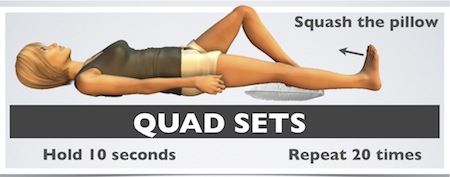
Place a pillow lengthwise under your knee. Pull your toes back and push your leg down to squash the pillow. Hold for 10 seconds and repeat up to 20 times. You should feel your thigh and gluteus muscles during this exercise. Begin with moderate effort and then increase your effort gradually. This exercise can be done lying flat as shown, sitting in a recliner, or leaning against a wall.


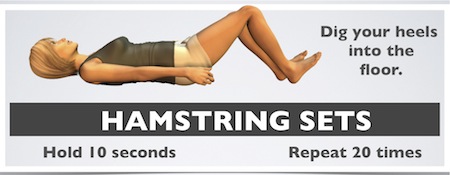
#2 Hamstring sets
Lie on your back with knees bent and toes up. Dig your heels into the ground and pull back without sliding your heels. Hold for 10 seconds and repeat up to 20 times. You should feel the back of your thigh, the hamstrings, during this exercise. As with quad sets, start with a moderate effort and increase your effort gradually.


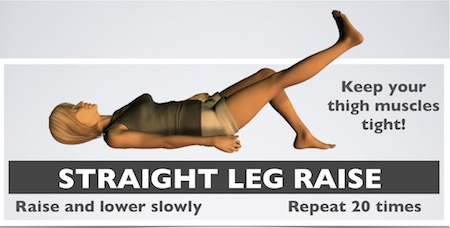
#3 Straight leg raise
Tighten your thigh and pull your toes back just as you do for the quad set, then maintain the muscle tightness as you slowly raise your leg 18 inches. Lower slowly, relax your muscles briefly, then tighten your thigh, pull your toes back and repeat 20 times.Note: These first 3 knee exercises are the least stressful on the knee joint as they require little to no movement of the knee itself.

16K+

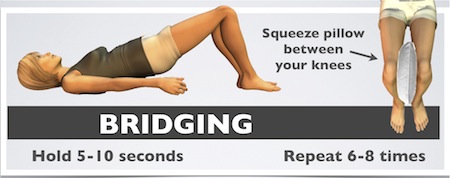
#4 Bridging
Knees bent and feet flat on the floor as above with your heels spaced comfortably from your bottom. Fold a bed pillow in half, and place it between your knees. Squeeze the pillow and hold on to it tightly. Raise your bottom upward slowly lifting one vertebra at a time from your exercise mat. Continue lifting your bottom upward until there is a straight line from your shoulders to your knees. Hold this position 5-10 seconds. Repeat 6-8 times. Think of reaching your knees forward over your ankles.


Note: If this exercise is uncomfortable, just squeeze the pillow and hold it 10 seconds. This is called an adductor set, as it works the inner thigh muscles. Once you can do this (and knee exercises #1 and 2) 20 times with a strong effort, try bridging again.


#5 Knee extension
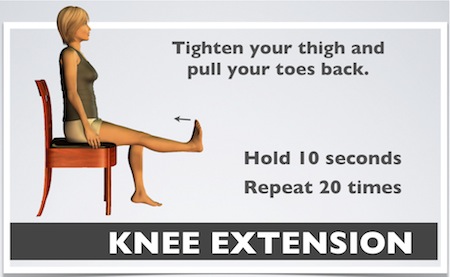
Sit upright in a chair, straighten your leg, tighten your thigh and pull your toes back. Hold for 10 seconds and repeat up to 20 times. The more you tighten your muscles, the better results you’ll get from this exercise. You may feel a stretch behind your knee during the exercise. For a greater challenge, straighten both legs at the same time, or do this exercise with an adjustable ankle weight up to 5 pounds.
If you feel a strong stretch behind your knee during the exercise, pump your ankle (point your toes and flex your foot back) several times instead of just holding your toes back--this will help improve your flexibility. Find more stretches here. 


Note: Knee exercises #6 and 7 are intro balance exercises.
#6 Heel raises
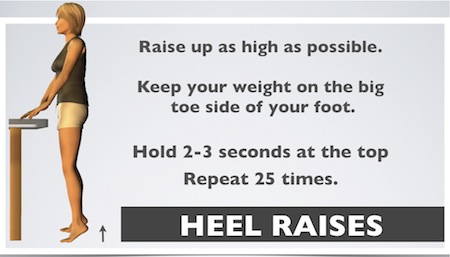
Hold onto a chair or countertop only as much as you need to for safety. Go up on your toes as high as possible without leaning your body weight forward. Stay up and maintain your balance for 2-3 seconds. Repeat up to 25 times. Keep your weight over your big toes as you go up and down.Once you can easily do 25 repetitions, try lowering back down on one foot. Then progress to single leg heel raises. 

16K+
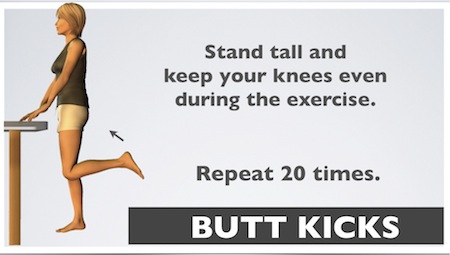
#7 Butt Kicks
Keep your knees in line and lift your heel toward your rear end, as high as possible.  Stand upright when you lift your heel.  You will feel your hamstring muscles during this exercise, and you may feel a stretch in the front of your thigh.  Repeat up to 20 times per side.  Add an ankle weight to increase the challenge.


Comments

Popular posts from this blog

Gout is a type of arthritis that develops when blood uric acid levels are abnormally high

Gout is a type of arthritis that develops when blood uric acid levels are abnormally high. The uric acid forms crystals in the joints, often in the feet and big toes, which causes severe and painful swelling. Some people need medication to treat gout, but diet and lifestyle changes may also help. Lowering uric acid can reduce the risk of gout and may even prevent subsequent flares in people with this condition. However, gout risk depends on several factors, not just lifestyle, so it is important to talk to a doctor about the best gout prevention strategies. In this article, learn about eight natural ways to lower uric acid levels. https://gathiyarog.com/ 1. Limit purine-rich foods Reducing alcohol intake may lower the risk of gout. Purines are compounds that occur naturally in some foods. As the body breaks down purines, it produces uric acid. The process of metabolizing purine-rich foods may lead to gout by causing the body to produce too much uric ac...

The Best Time of Day to Walk and Exercise

                                              FITNESS plus Get Healthy, Strong Knees With This 10 Minute Workout https://gathiyarog.com/ FITNESS Get Healthy, Strong Knees With This 10 Minute Workout Take 10 minutes each day to strengthen your knees. 1  / 6 Knee Exercises For Stronger Joints Knees: They’re one of the most common joints that people complain about. Many factors play into chronic knee discomfort, including muscular imbalance, excessive impact over time, age and onset of osteoarthritis. The good news is that discomfort doesn’t mean that you need to be sedentary. And in most cases, you can enhance the health of your joints through proper  nutrition  and tailored exercise. After the age of 30, there is a steady decline in muscle mass and strength in our  knees . This decline can be as much...